
Movement Snacks: 9 Simple Two-Minute Habits That Help Break Up Hours of Sitting

Many people believe that exercising for 30 to 60 minutes provides all the movement their body needs for the day.
Regular exercise is extremely important. However, a morning workout does not necessarily change the fact that you may spend the next eight hours sitting at a desk, driving, attending meetings, or looking at a screen.
This is one reason “movement snacks” have become a growing health and wellness topic.
A movement snack is a short burst of physical activity performed at different times throughout the day. It may last anywhere from two to ten minutes and usually requires little or no equipment.
The goal is not to complete an exhausting workout every hour.
The goal is to interrupt long periods of sitting and give your joints, muscles, and cardiovascular system regular opportunities to move.
Research has found that breaking up prolonged sitting with brief periods of light movement may support circulation and metabolic health. Some studies have specifically examined two-minute walking breaks performed approximately every 30 minutes. Movement snacks should still be considered an addition to—not a replacement for—recommended cardiovascular and strength-building exercise.
Here are nine simple movement snacks you can use throughout your day.
1. Take a Two-Minute Walk
Walking may be the simplest movement snack.
Walk around your office, through your home, down the hallway, or around the outside of your building.
You do not have to walk quickly. The goal is to stand, change position, activate the muscles of the legs, and give your body a break from sitting.
Consider walking:
After completing a phone call
Between meetings
After checking email
After finishing a meal
Before getting into your vehicle
When you return home from work
A short walk is often easier to repeat than a complicated exercise routine.
2. Perform Chair Sit-to-Stands
Sit near the front of a stable chair with your feet comfortably positioned on the floor.
Stand up under control and then slowly sit back down.
Repeat the movement five to ten times.
Chair sit-to-stands activate muscles in the legs and hips that remain relatively inactive while you are seated.
Use a stable surface for support if you have difficulty with balance. Stop if the exercise causes sharp discomfort, dizziness, or instability.
3. March in Place
Marching in place can be performed almost anywhere.
Stand near a stable desk, wall, or countertop if you need additional balance support.
Lift one foot, place it down, and alternate sides for 30 to 60 seconds.
Allow your arms to move naturally.
You can keep the movement small and comfortable. The objective is to get your hips, knees, ankles, and arms moving again.
4. Perform Heel Raises
Stand behind a sturdy chair or near a counter.
Slowly rise onto the balls of your feet. Pause briefly and lower your heels back to the floor.
Repeat the movement ten to twenty times.
Heel raises activate the calf muscles and encourage movement through the ankles and feet.
This can be an especially convenient movement snack after sitting at a desk or riding in a vehicle.
5. Move Your Shoulders and Upper Back
Desk work often places the arms in front of the body for long periods.
This may encourage the shoulders to move forward and the upper back to remain relatively still.
Stand or sit upright and gently move your shoulder blades backward. Avoid aggressively forcing your shoulders down or arching your lower back.
You can also perform comfortable arm circles, reach forward, or gently rotate the upper body.
The movement should feel controlled and comfortable.
6. Reach Overhead
Standing overhead reaches can provide movement through the shoulders, rib cage, and upper body.
Stand comfortably and raise both arms upward within a comfortable range.
Avoid forcing the movement or leaning excessively backward.
Lower your arms and repeat five to ten times.
You can combine the reach with slow breathing to help you relax after concentrated desk work.
7. Take the Stairs
Walking up one or two flights of stairs can serve as a brief exercise snack.
Stair climbing generally requires more effort than walking on a flat surface, so begin slowly and use the handrail when appropriate.
People with significant knee, hip, balance, cardiovascular, or respiratory concerns should select an activity that is appropriate for their current health and physical abilities.
8. Move During Phone Calls
Phone calls provide an easy trigger for movement.
Instead of remaining seated, stand or walk whenever you are on a call that does not require you to look at a computer.
You might:
Walk around the room
Perform heel raises
Shift your weight from side to side
March gently in place
Move your shoulders
Walk outside
Attaching movement to an activity you already perform makes the habit easier to remember.
9. Walk After Meals
A brief walk after breakfast, lunch, or dinner can help you add movement without creating another complicated appointment in your schedule.
Even a few minutes can interrupt sitting and help establish a consistent daily routine.
Begin with a comfortable duration and pace. The goal is to create a habit you can sustain.
How Often Should You Take a Movement Snack?
There is no single schedule that is perfect for every person.
A reasonable starting strategy is to stand and move for two to five minutes every 30 to 60 minutes during prolonged sitting.
People who have been inactive may need to begin with fewer breaks and gradually build consistency.
You can use:
A phone alarm
A smartwatch reminder
A computer notification
A timer
A calendar reminder
A visual note beside your monitor
The best reminder is the one you will actually follow.
Do Movement Snacks Replace Exercise?
No.
Movement snacks are meant to complement a complete physical activity routine.
Adults should still work toward appropriate amounts of aerobic activity and muscle-strengthening exercise based on their health, abilities, and professional recommendations.
Think of structured exercise as your primary training program.
Movement snacks help fill the inactive spaces between those workouts.
Both are important.
Can Movement Snacks Improve Posture?
Movement snacks may help reduce the amount of time your body remains in one static posture.
However, no single movement or exercise can permanently create perfect posture.
Posture is affected by many factors, including:
Workstation setup
Mobility
Strength
Fatigue
Vision
Stress
Habit
Previous injuries
Joint function
The type of work being performed
The best posture is often your next posture.
Changing position frequently may be more realistic than trying to hold one supposedly perfect position throughout the entire day.
When Should Persistent Stiffness Be Evaluated?
Occasional stiffness after sitting may improve after you stand and move.
An evaluation may be appropriate when stiffness:
Occurs every day
Continues after movement
Progressively worsens
Limits normal activities
Frequently disturbs sleep
Is accompanied by numbness or weakness
Began after an injury
Affects balance or walking
Prevents you from exercising normally
Persistent symptoms can involve more than one factor. Joint restrictions, muscle weakness, reduced mobility, previous injuries, workplace habits, and other health conditions may all contribute.
How Pro Active Chiropractic Center Can Help
At Pro Active Chiropractic Center in Palmyra, Missouri, Dr. Scott Stiffey evaluates how the spine, joints, muscles, posture, and movement patterns are functioning together.
Depending on the patient’s needs, conservative care may include chiropractic adjustments, acupuncture, spinal decompression, therapeutic exercise recommendations, laser therapy, shockwave therapy, PEMF, and other approaches.
The goal is not simply to chase a temporary symptom.
The goal is to help patients improve mobility, function, and their ability to remain active.
Pro Active Chiropractic Center serves patients from Palmyra, Quincy, Hannibal, Canton, La Grange, Monroe City, Lewistown, New London, and surrounding Northeast Missouri and Western Illinois communities.
Contact the office to schedule an evaluation.
Start With Two Minutes
You do not need to completely rebuild your schedule to move more.
Begin with one simple habit:
Every 30 to 60 minutes, stand up and move for two minutes.
Walk.
Reach.
March.
Squat.
Move your shoulders.
Take the stairs.
Small actions performed consistently can gradually create a more active day.
Your body was designed to move—not only during a workout, but throughout the day.
25. FREQUENTLY ASKED QUESTIONS
What is a movement snack?
A movement snack is a brief burst of physical activity performed during the day. It commonly lasts two to ten minutes and may include walking, stair climbing, chair squats, marching, mobility exercises, or other simple movements.
How long should a movement snack last?
A movement snack can last approximately two to ten minutes. Even a short break can help interrupt an extended period of sitting.
How often should I stand up from my desk?
A reasonable starting point is to change position or move for two to five minutes every 30 to 60 minutes. Your ideal frequency may depend on your health, work responsibilities, and physical abilities.
Do movement snacks count as exercise?
They contribute to your overall daily physical activity. However, they should not completely replace regular cardiovascular exercise, resistance training, mobility work, and other appropriate activity.
What is the easiest movement snack?
A two-minute walk is usually one of the easiest options. Walking around your office, home, or building requires no special equipment.
Can movement snacks help stiffness?
Changing position and moving the joints and muscles may help some people feel less stiff after prolonged sitting. Persistent or worsening stiffness should be appropriately evaluated.
Can I perform movement snacks at work?
Yes. Walking, chair sit-to-stands, heel raises, marching, shoulder movements, and standing during phone calls can often be performed in a workplace.
Are movement snacks suitable for older adults?
Many movement snacks can be modified for different mobility levels. Older adults or people with balance concerns should use stable support and choose movements appropriate for their health.
Are movement snacks safe for everyone?
Not every activity is appropriate for every person. People with significant medical conditions, recent surgery, balance problems, or new symptoms should consult an appropriate healthcare professional before starting unfamiliar exercises.
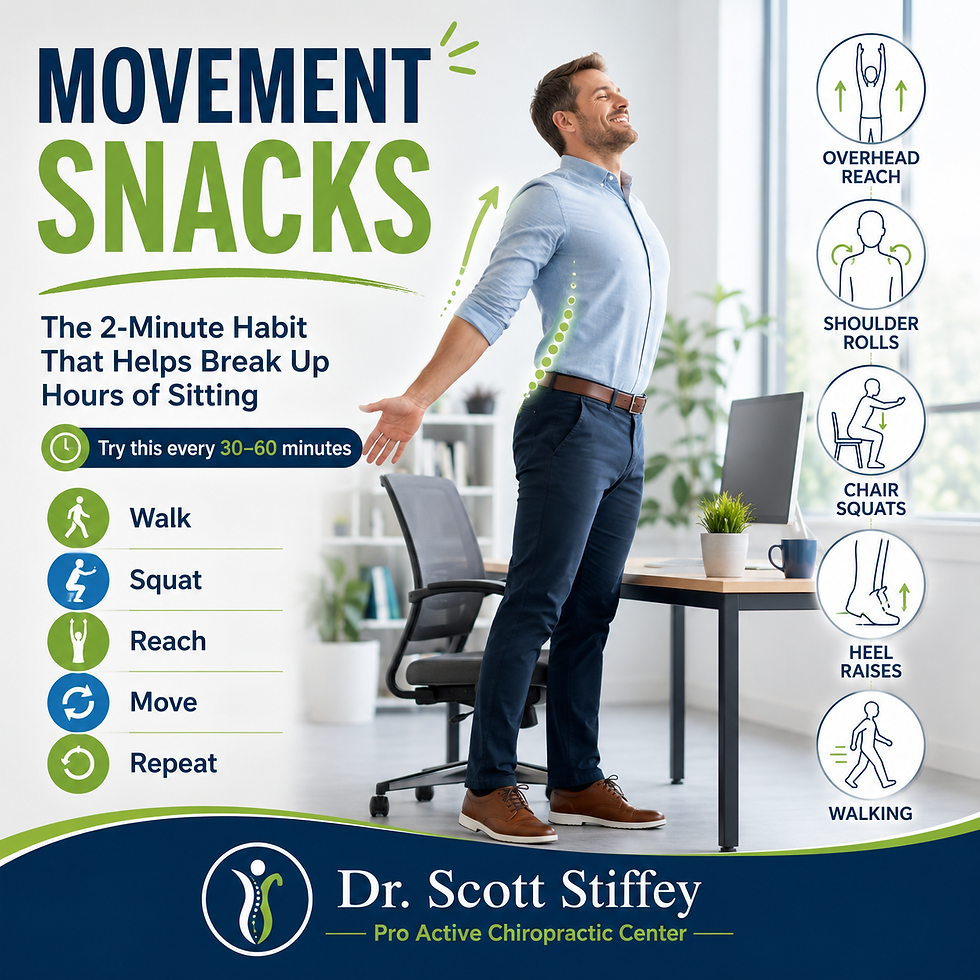
Movement breaks help you avoid remaining in one position too long. Posture is complex, however, and may also be influenced by strength, mobility, workstation setup, fatigue, vision, stress, injuries, and joint function.


Comments